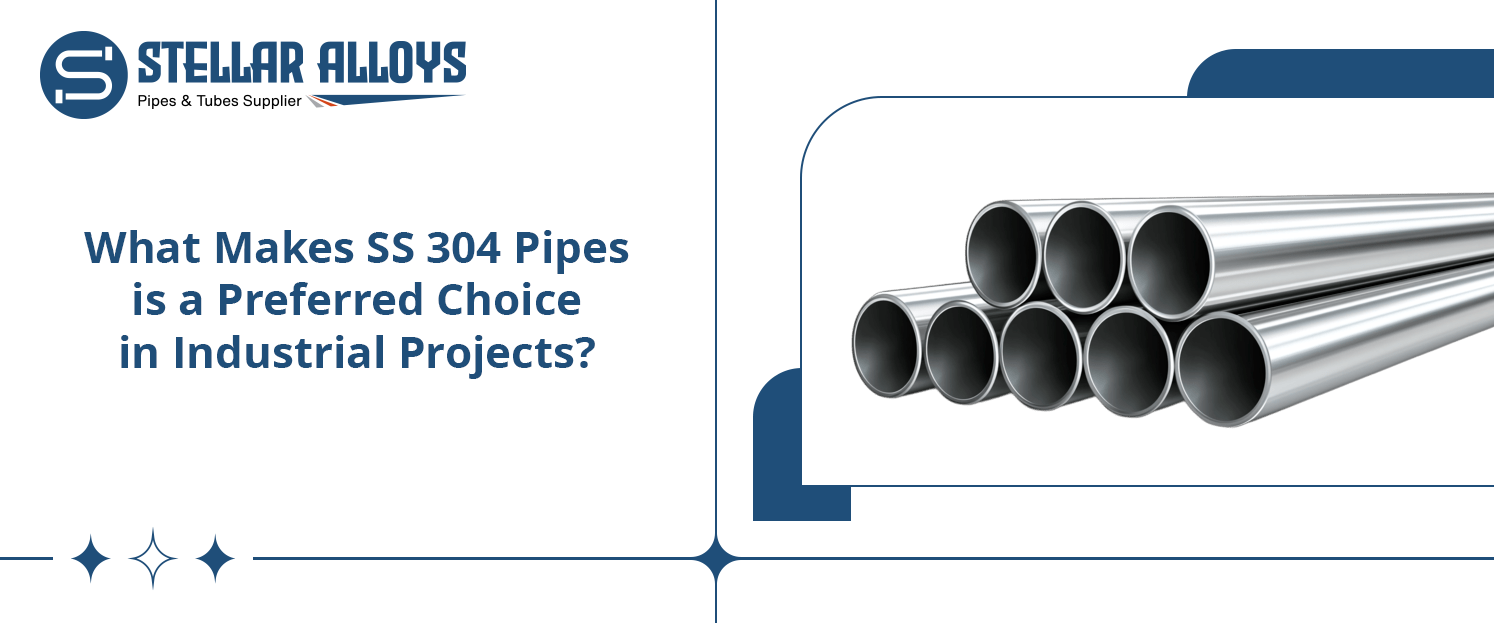
What Makes SS 304 Pipes a Preferred Choice in Industrial Projects?
In case of a runoff by engineers and procurement teams in selecting piping alternatives to the industrial projects, 304 stainless steel pipe is always the first choice. In Mumbai food processing plants to the chemical plants of the Gulf, ss 304 pipe has proven to be the most effective combination of corrosion resistant, mechanically strong and economical pipe material that can be found in any material. In line with ASTM A312 TP304 – one of the most used standards of stainless steel piping – these pipelines have a wide range of applications involving both the environment, temperature, and pressure. You need 304 stainless steel in the amount of 304 stainless steel tube to feed the pharmaceutical lines, or need the 304 stainless steel in the form of 304 stainless steel pipe to support the structural structures, whatever the case, knowing the important properties and the specifications of 304 stainless steel pipe will aid you in making the correct procurement decision.
What Is a 304 Stainless Steel Pipe?
SS 304 pipe is a part of the austenitic stainless steel. The main alloying components are chromium (18-20%), and nickel (8-10.5%), that form a passive oxide layer on the surface. This coating serves to provide a natural resistance to moisture, acidic dilutions and the majority of atmospheric environments. What is obtained is a pipe which does not need to be coated externally to ensure its integrity, and hence is a low-maintenance pipe in a long-duration industrial installation.
Austenitic microstructure is also what makes 304 stainless steel pipe have a non-magnetic nature and high toughness over a very wide temperature range -40 deg C down to cryogenic service to continuous oxidation service at 925 deg C. All these feature it in cold-chain facilities as well as in high-temperature process lines.
304 Stainless Steel Pipe Specifications and ASTM A312 TP304
It is important to note that one has to know the specifications of 304 stainless steel pipes before making any order in the industry. The main standard of control is the ASTM A312 standard that addresses seamless and welded, as well as heavily cold-worked austenitic stainless steel pipes. In this standard, the grade of 18/8 chromium-nickel composition is known as TP304.
Key mechanical and dimensional benchmarks for ASTM A312 TP304 include:
Tensile Strength: 515 MPa (minimum)
Yield Strength: 205 MPa (minimum)
Elongation: 35% minimum
Hardness: Brinell 201 / Rockwell B92
Carbon content: 0.08% maximum
Diameter range: 1/8″ to 36″ NPS
Wall thickness: SCH 5S to SCH 160
Other applicable standards include ASTM A213 (for tubular products used in boilers and heat exchangers) and ASTM A269 (for general-service tubing). For a deeper look at how seamless and welded construction differ in practice, refer to our guide onSeamless vs. Welded Stainless Steel Pipes.
304 Stainless Steel Tube Sizes: What Buyers Need to Know
In contrast to pipes, which are characterized by nominal pipe size (NPS) and by schedule, the sizes of 304 stainless steel tubes are characterized by actual outside diameter (OD) and by wall thickness. The above difference is important in cases that require precision like in instrumentation, heat exchangers, and pharmaceutical processing where a diameter must be controlled with precision.
Popular standard sizes of stainless steel tube include 304, and sizes vary between 6mm OD in instrument tube of a thin wall to 168mm OD in structural and process applications. Wall thickness will normally vary between 0.5mm and 20mm based on the service requirement. When ordering, one should always disclose whether the specification is based on NPS (pipe) or OD (tube) lest he runs the risk of finding himself in an expensive misfit and pressure rating.
Why 304 Stainless Steel Pipe Is Preferred in Industrial Projects
The ss 304 pipes have a chromium-nickel composition which offers reliable resistance against oxidation, low-acid environments, and water. It works very well in food processing plants, water treatment plants, pharmaceutical clean rooms, chemical storage systems – it can be used without surface degradation that carbon steel experiences over time. However, it should be noted that grade 316 with added molybdenum has better pitting resistance in the presence of chlorides and other harsh environments, e.g., coastal or marine.
Good Weldability and Fabrication Flexibility
The weldability of ss 304 pipe is one of the practical benefits that underlies its adoption in the fabrication of the project. It supports normal fusion welding techniques i.e. TIG, MIG and high-frequency resistance welding that do not need post-weld heat treatment in most situations. This saves time on fabrication, as well as labour on site, especially when installing large scale work where hundreds of pipe joints need to be finished effectively.
Extensive Operating Temperature
304 stainless steel tube still maintains its mechanical integrity in cryogenic temperatures to about 870degC in intermittent service. This wide thermal operating range enables it to be used both on cold utility lines in the refrigeration systems and hot process lines in the chemical or petrochemical plants – and in the same plant.
Sensitive Operation Hygienic Surface Finish
The 304 stainless steel pipe is non-porous and smooth and can be cleaned easily and is resistant to biofouling. It is the material of choice in hygienic piping, in food and beverage processing, dairy facilities, breweries and pharmaceutical production – anyplace contamination of products must be kept to a minimum.
Long-Term Cost Efficiency
Although the initial cost of 304 stainless steel pipe is greater than carbon steel products, the overall cost of the life-cycle is usually less. Low maintenance, no external layer, and lifespan in the service of decades without any major degradation means that there is a low rate of replacement and low downtime to industrial operators.
Key Industrial Applications of SS 304 Pipes
The ease of 304 stainless steel pipe has seen it occur in virtually all industries of importance:
Pharmaceuticals: Clean fluid processing, clean water distribution, line feed reactor.
Chemical Processing: Pipelines, reactors, storage vessels, which deal with acid.
Construction & Architecture: Railings, column supports used in the construction of the cladding.
Water supply and treatment Plumbing On-site treatment of wastewater, desalination pre-treatment.
Cryogenics: The service lines of low temperature and austenitic toughness would be needed.
For applications involving high-salinity water or aggressive chemical exposure, consider reviewing our blog onSS 316 Stainless Steel Pipe Properties and Applications to determine whether the upgraded grade is warranted for your project.
SS 304 vs SS 316: Choosing the Right Grade
Property
SS 304 Pipe
SS 316 Pipe
Alloying Elements
Cr 18–20%, Ni 8–10.5%
Cr 16–18%, Ni 10–14%, Mo 2–3%
Corrosion Resistance
Excellent for most environments
Superior in chloride/marine conditions
Pitting Resistance
Good
Significantly better
Cost
More economical
Higher cost
Weldability
Excellent
Excellent
Typical Standard
ASTM A312 TP304
ASTM A312 TP316
Best For
Food, pharma, general industrial
Marine, chemical, offshore
Seamless vs. Welded 304 Stainless Steel Pipe: Which Should You Specify?
Under ASTM A312 TP304, both the seamless and welded construction exist. The seamless 304 stainless steel pipe is made by extrusion of a solid billet and therefore has no longitudinal weld joint. This gives it an advantage over high-pressure systems and critical process lines as well as where absolute uniformity of the pipe wall must be obtained. Welded pipe, known in the plate as rolled and the edges joined together, is less expensive and more popular in structural, low pressure, and architectural purposes.
In the majority of general industrial uses, such as water distribution, HVAC, light chemical service, welded 304 pipe will offer sufficiently good performance at reduced procurement price. In the case of hydraulic lines, boiler feed water systems and high-purity pharmaceutical service, specify seamless.
Further Reading on Steel Pipe and Tube Selection
To strengthen your material selection process, explore these related resources on steelpipeandtubes.com:
The secret of 304 stainless steel pipe remains popular in the industrial project lies in one single factor; this should be the performance that is reliable in the widest scope of use that is supported by established international standards. It could be a 304 stainless steel tube to meet the needs of a pharmaceutical clean room, large-bore ASTM A312 TP304 pipe to meet the demands of a processing plant, structural sections to meet the needs of an architectural installation, this grade provides the same performance at a price that makes project economics a real activity in the long term.
Stellar Aloys Steel Pipe and Tubes also offer ss 304 pipes, both seamless and welded, in the entire selection of sizes and schedules of 304 stainless steel tubes. Contact our technical department and talk with them about the 304 stainless steel pipe specifications in your upcoming project.