
Seamless vs Welded Steel Pipe: Strength, Pressure & Cost
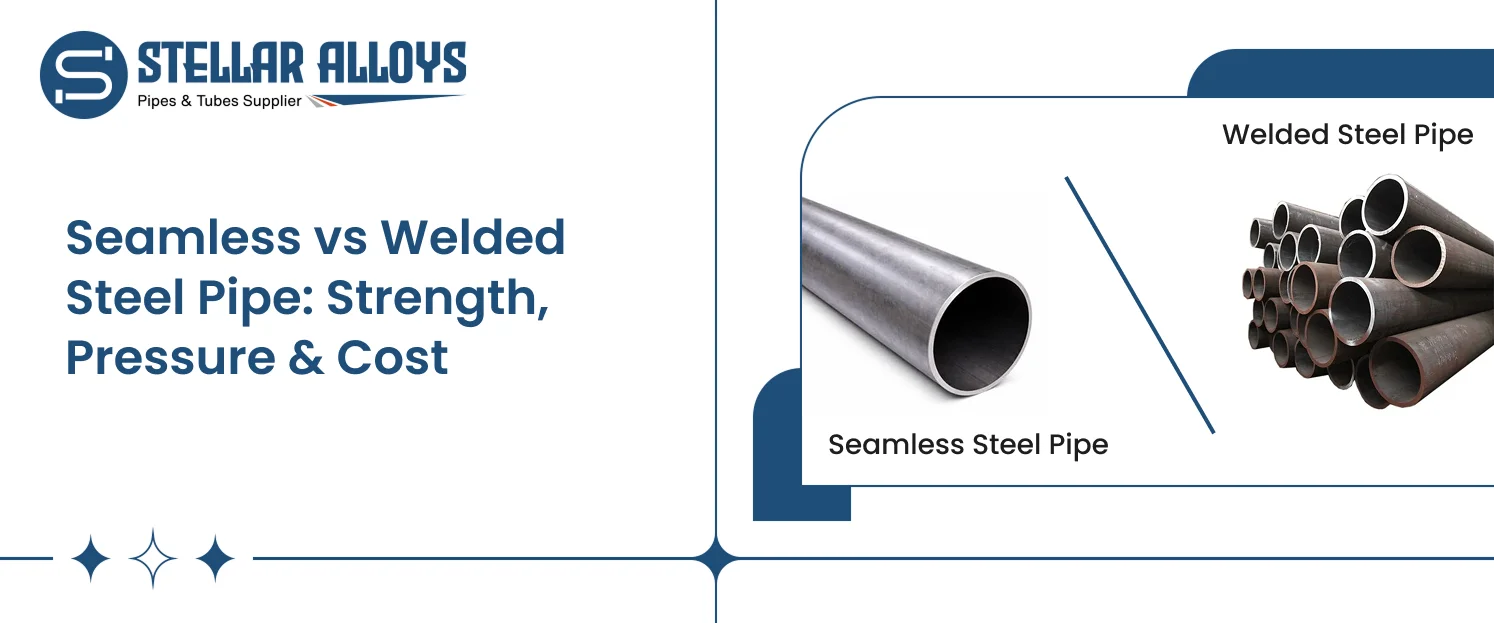
Welded pipe is not weaker than seamless pipe. The steel is the same steel, the mill certificate says so, and a sound ERW weld will usually fail a tensile test somewhere other than the seam. What is true is that the design code does not extend it the same trust. ASME B31.3 applies a weld joint quality factor of 1.00 to seamless pipe and 0.85 to electric resistance welded pipe, and that one number is where the real difference sits. It is not a strength difference. It is a design allowance difference, worth roughly 15 to 18 per cent more wall thickness for the same duty, and it is the whole reason the seamless and welded pipe argument keeps outliving the metallurgy behind it.
Which is stronger, and why that is the wrong question
Both routes start from the same steel and end at the same grade on the certificate. Seamless is pierced from a solid billet and elongated. Welded is formed from strip or plate and joined along a longitudinal or spiral seam.
The seam is the only difference, and on modern high frequency ERW or fully examined fusion welded product it is not a weak point in any way a tensile test would show.
So the honest answer to “which is stronger” is: for the same grade and the same wall, they are equivalent in material strength.
The useful question is different. How much does the design code allow you to count on? That is what the quality factor answers, and it is a statement about confidence and inspectability, not about the metal.
Which handles higher pressure
Pressure capability comes from the wall thickness design equation, and the weld joint quality factor sits inside it as a multiplier on allowable stress. Lower factor, lower allowable stress, thicker wall required for the same pressure.
The basic factors published in ASME B31.3:
|
Weld type |
Basic quality factor, Ej |
|---|---|
|
Seamless, no longitudinal weld |
1.00 |
|
Electric resistance welded (ERW) |
0.85 |
|
Electric fusion welded, single or double butt |
0.80 to 1.00, depending on examination |
|
API 5L spiral, submerged arc |
0.95 |
|
Furnace butt welded |
0.60 |
These are typical published values. Table numbering and factors change between code editions. Confirm against the current edition of ASME B31.3 before applying any of this to a design.
Three consequences worth knowing:
ERW is stuck at 0.85. Unlike fusion welded product, the factor for electric resistance welded pipe cannot be raised by additional radiography or examination. If the design needs a higher factor, ERW is not the route, however much inspection is thrown at it.
Electric fusion welded pipe can reach 1.00. Double butt welded product with full radiographic examination gets there, and some welded specifications build that examination into the material specification, so the pipe arrives already qualified at the top factor.
Furnace butt welded at 0.60 rarely matters. It is limited to the lightest fluid service category and to small standard wall product, so its low factor almost never governs a real selection.
The practical translation: at 0.85, an ERW line needs roughly 15 to 18 per cent more wall than a seamless one for the same conditions. Sometimes that is one schedule step. Sometimes the next schedule up is not commercially available in that size, and the decision makes itself. The steel pipe size chart shows where the steps fall.
Which is cheaper
Welded is normally cheaper, and the gap generally widens with diameter.
The reason is manufacturing. Piercing a billet and rolling it out is energy intensive, slow, and gets harder as diameter and wall increase. Forming plate and welding a seam scales far more comfortably. Above the mid range of diameters, welded is often not merely cheaper but the only realistic route, because seamless production above a certain size becomes specialised or unavailable.
Two places the assumption reverses:
- Small bore, heavy wall. In the smaller sizes, seamless is standard, widely stocked and frequently the cheaper option, because welded product in those dimensions is not the volume item.
- When the wall step cancels the saving. If the 0.85 factor pushes the design up a schedule, the extra steel can eat the price advantage. That calculation is worth running rather than assuming. The steel pipe weight chart gives the weight per metre for each schedule, which is where the cost actually lives.
There is also a delivery dimension. Availability, not unit price, is frequently the deciding factor on a live project, and it moves constantly. We will tell you honestly which route we can actually deliver in your size and timeframe, including when that is the cheaper one.
Which is better for oil and gas
Historically this sector leaned hard toward seamless, and much of that preference is still written into client specifications.
There are real reasons behind it: cyclic loading, sour service, high pressure, and locations where an inspection is expensive and a failure is worse. In sour service in particular, the weld and heat affected zone need specific qualification, and the requirements are demanding.
There are also inherited reasons. Some specifications say seamless because they have said seamless since before high frequency welding matured, and nobody has revisited them.
Both things can be true. If the specification says seamless, that is the requirement, and arguing metallurgy at the enquiry stage will not change it. But it is worth knowing which kind of “seamless only” you are dealing with, because on new specifications there is often room for a discussion, and on legacy ones there is not.
Which is better for chemical processing
Here the corrosion resistance of the grade does most of the work, and the manufacturing route matters much less than it does under pressure or fatigue loading.
Welded stainless is used extensively and successfully in process plant. SS 304 pipe and 316L in welded form are ordinary, well-proven choices for a great many duties.
Where the route earns closer attention:
- Weld decay in the heat affected zone. This is what the L grades exist for. Low carbon reduces chromium carbide precipitation at grain boundaries, which is why 304L and 316L are specified for welded fabrication rather than the straight grades.
- Highly aggressive media. Where the corrosion margin is thin, a seam is one more feature to inspect and one more thing that has to be right.
- Surface finish and cleanability. For sanitary and pharmaceutical duty the internal finish requirement often drives the choice more than either strength or pressure.
Can welded pipe replace seamless pipe?
Sometimes yes, sometimes no, and the distinction is not always technical.
Where the answer is yes: the design accounts for the correct quality factor, the wall is sized accordingly, the specification permits welded product, and the service is not one where the seam is a specific liability. This describes a very large share of process piping.
Where welded reaches parity: fully radiographed double butt welded product, and welded specifications that build 100 per cent examination in as a class requirement. Certain welded duplex 2205 and super duplex pipe classes work this way, arriving qualified at a factor of 1.00 with no wall penalty against seamless.
Where the answer is no: when the client specification, the project specification or the applicable code says seamless. That constraint is real whatever the engineering merit, and it is not a decision a supplier gets to override. If a substitution genuinely makes sense on a project, it goes through a deviation request approved by the design authority. It does not go through a purchase order note.
Standards matter here too. Some specifications permit both routes and some do not, which is covered in ASTM A312 vs A269 vs A213.
What to tell us at enquiry
If the route is already fixed by your specification, say so and we will quote to it. If it is open, tell us:
- Grade and specification
- Size, as OD and wall or NPS and schedule
- Design pressure and temperature, if the wall is not already fixed
- Whether welded is permitted by the governing specification
- Quantity, length and end finish
Send us the OD, wall, schedule and length and we will confirm what is available in both routes, with the honest answer on which one suits the timeline. Our stainless steel pipe and tube range covers both.
Frequently asked questions
seamless and welded pipe? Yes, A312 covers seamless, welded and heavily cold-worked pipe. What changes is the design allowance applied downstream. See ASTM A312 vs A269 vs A213 for how the three standards differ on manufacturing route.